Categories
In the Parks WDW vs DLP

WDW vs. DLP: Frontierland (Part Four – The Wildest Rides in the Wilderness)

The description in the Disneyland Paris park map for Big Thunder Mountain tells you that riders will “Hurl through an abandoned gold mine at breathtaking speed aboard a runaway mine train!” Although I do not agree that the mine is supposed to be abandoned (especially as you can clearly hear a miner call out “Fire in the hole”) this is still a fair description of all four versions of the attraction (Paris, Anaheim, Orlando and Tokyo) and—to a lesser extent—Hong Kong’s Big Grizzly Mountain Runaway Mine Cars.

For the sake of completeness, I should point out that whereas the attractions in Florida and California are called “Big Thunder Mountain Railroad”, the word “Railroad” is missing from the official titles in Paris and Tokyo. Of these four versions, the one in Paris is the fastest, tallest and longest although this doesn’t necessarily make it the best.

The Paris attraction has a much shorter exterior queue area than Florida, mainly due to the weather but also because less space here is needed: Queues tend to not be as excessive in France, the area to be traversed is not as steep, and the surrounding area has already immersed you in the world of the Big Thunder Mining Company.

Whereas Fastpass users have the same exterior scenery as regular riders in Florida, in Paris the two have very different sets to look at prior to entering the main building. Also, Fastpass users in Paris enter the building much nearer the load station than in WDW.

The interior queue areas of the two are very similar in layout, but different in terms of style. In essence, this is because Paris hasn’t got the interactive attractions which were added to WDW’s BTM queue earlier this year. However, the tone is more serious in Paris—the signs are less jokey and the sound effects are less over the top.

Once one gets to the ground floor (via stairs in Paris or a ramp in Florida) the décor is much the same. The start of the ride is pretty different though, seeing as it features an outdoor section in Paris, and a section with bats in Florida. In Paris, the bats come later.

Paris riders have a slightly longer darkened section here, because the track needs to take them under the Rivers of the Far West and onto the island where the majority of the attraction takes place.

The scenery of the next section in Paris—the first ascent—is very similar to that of its Floridian cousin, with very little on the left and the beautiful rainbow caverns on the right. Both ought to then take you through a stylized waterfall, although this effect in France rarely works.

The attraction continues being similar until just after the opossums. In Paris, this next portion doesn’t have the trip through Dave V. Jones Mine or the storage shed, although it does feature a dip into water—where you have your photograph taken—as well as an animatronic goat trying to pull Jeans off a clothes line.

This takes us to the second ascent. It is usually about here that one realizes the differences in sightlines. For example, in Paris, riders can see many other attractions (such as Tower of Terror or PanoraMagique) which ruin the theming, spoil the magic and remind you that you are not really in the American West.

Conversely though, riders in WDW can often see at least one of the other four trains, thus making the experience feel less unique. This rarely occurs in DLP, not least because more of the attraction is covered and fewer trains usually run in one go.

From this point onwards—with the exception of health-and-safety measures and the positioning of some of the props—the two attractions are very similar until exiting the third ascent, where in DLP you are almost instantly brought back under the water to the load/unload area.


Categories
In the Parks WDW vs DLP

WDW vs. DLP: Frontierland (Part Three – Rivers of America vs. Rivers of the Far West)

Whilst it has been made clear which rivers are referred to in the name of WDW’s Rivers of America (the Potomac, the Rio Grande, the Columbia and the Mississippi), it is as yet unstated which ones the Paris equivalent (Rivers of the Far West) is themed to, although the Mississippi and the Missouri are the two referred to most often by Imagineers in this context.

Rivers of America encompasses Tom Sawyer Island, whilst there are several islands within Rivers of the Far West. One of these is the home to Big Thunder Mountain, one separates Smugglers’ Cove (the load/unload area for the former Keel Boat attraction) from the rest of the water and several of the others make up Wilderness Island (where a “Lil’ Big Thunder” was once considered).

DSC02227
A detail from Smugglers’ Cove.

As well as the Keel Boats (and Cast Member-only motorized skiffs), other vehicles sometimes visible on the Rivers in Florida include rafts and canoes. Whilst Disneyland Paris has never had the former, nor the need for them, the latter operated in France for the first two years of the park’s existence until being discontinued due to the waterways being considered too busy.

The most iconic vehicles to travel the Rivers however are much bigger. Florida has the Liberty Belle, whilst Paris has the Mark Twain and the Molly Brown, although a maximum of one of the two in France will operate on a given day. All three feature onboard audio. Like the Liberty Belle, the Mark is a sternwheeler, whereas the Molly is a sidewheeler.

An advert for the Mark Twain which can be found on DLP’s Main Street.

The Paris boats are better covered from the elements and their equivalent of Riverboat Landing loads Guests into the bottom story rather than the second floor. The view from all three includes animatronic animals, live ducks, the Railroad and Old Joe, the fisherman.

Whilst most of the visuals along the Rivers of America are thematically manmade (such as the Native American village), on show for those touring the Rivers of the Far West are more nature-inspired features, such as a geyser –which, due to frozen pipes, no longer erupts- and a mock-up of a natural rock bridge, in reality fabricated of steel and concrete.

In both Florida and Paris, the Riverboats are travelling along I-beam tracks and take just under a quarter of an hour to complete a tour of their respective River. In Florida, this round trip takes place in a clockwise direction; it is counter-clockwise in France.

DSC01242 DSC01241The Molly Brown in dock in the early evening, in front of Phantom Manor (left) and Big Thunder Mountain (right).


The photos below were taken onboard the Molly in Oct 2013.

DSC02224

DSC02220

DSC02221

DSC02218

DSC02217

All photos courtesy of Hugh Allison. Please do not use without permission.

Categories
In the Parks WDW vs DLP

WDW vs. DLP: Frontierland (Part Two – Shops, Restaurants, Theatres and Shows)

In Florida, Frontierland has six very distinct shops (Big Al’s, Briar Patch, Frontier Mercantile, Frontier Trading Post, Prairie Outpost & Supply and Splashdown Photos) whereas there is really only one store in the Frontierland of Disneyland Paris. This is the Thunder Mesa Mercantile Building, although it is split into three separate parts: Bonanza Outfitters, Eureka Mining Supplies and Tobias Norton & Sons. To the untrained eye (e.g. mine) the three sections seem interchangeable, except for having different entrances, but perhaps the differentiation is to help out those who work in the park’s sales department…or maybe it is a cynical ploy to get more potential customers to visit/revisit the store.

DSC01907
Thunder Mesa Mercantile Building at dusk. October 2013.
DSC02210
Interior of Thunder Mesa Mercantile Building. Spot the obvious Hidden Mickey. October 2013.
DSC02204
Interior of Thunder Mesa Mercantile Building. Two of the store’s many decorative mannequins which originated in the nearby Legends of the Wild West. October 2013.

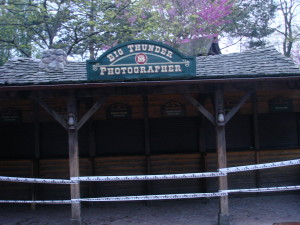
Arguably there is another sales point of sorts in DLP’s Frontierland: Big Thunder Photographer. As well as this being where one can purchase the on-ride snaps from Big Thunder Mountain, it also sells T-shirts, bottled beverages and plush toys, albeit currently only of Woody and Jessie.

DSC01233
Big Thunder Photographer – Photo taken in May 2013, when shop was undergoing refurbishment.

In terms of restaurants, Disneyland Paris hasn’t got anything too similar to any of the three eateries currently in WDW’s Frontierland: Golden Oak Outpost, Pecos Bills Tall Tale Inn and Westward Ho.

What Disneyland Paris does have however is the Silver Spur Steakhouse, a restaurant which once featured various watercolors, etchings and oil paintings by the likes of Albert Bierstadt (1830-1902), Edward Borein (1872-1945) and Charles Russell (1864-1926) so as to set the scene of “lavish Victorian ambience…accentuated with masterpieces of western art”. In 1994 however, these were removed and replaced with printed copies.

Whilst the Silver Spur Steakhouse is a table service restaurant, the other eateries in the Land are all generally considered to be “Quick Meal” experiences: Cowboy Cookout Barbecue (“Western style” food, and frequent live music and/or characters), Fuente del Oro Restaurante (Mexican food), Last Chance Café (Tex-Mex) and The Lucky Nugget Saloon.

DSC02239
Although looking slightly shabby now, this Aztec golden fountain sits in the forecourt outside “Fuente del Oro”. The restaurant name translates as “Fountain of Gold” which refers to this fountain. However, Fuente’s other meaning, source, means the eatery’s name is also a reference to the backstory of Big Thunder Mountain, which has its entrance opposite this fountain. backstory. October 2013.
DSC02249
A detail from the heated terrace added to the Last Chance Café in 2009. Many people are against this terrace as it spoils the view of the Land, and goes against the restaurant’s original theming. October 2013.
DSC01881
A seasonal addition above the Lucky Nugget. October 2013.

The Lucky Nugget Saloon is (in many ways) France’s answer to WDW’s The Diamond Horseshoe, although it is perhaps closer in design and atmosphere to Anaheim’s The Golden Horseshoe.

When I visited The Lucky Nugget last month, it was featuring shows by The Sun Flower Spooky Trio and The Thunder Mesa Band, with nearby performances by The Riverboat Halloween Band. Other shows at The Lucky Nugget over the years have included Lilly’s Follies, The Lucky Nugget Christmas Trio, The Lucky Nugget Revue and Rosie & The Rebels.

DSC01249
The Thunder Mesa Band performing inside The Lucky Nugget. May 2013.
DSC02250
The Riverboat Halloween Band, standing in front of Rivers of the Far West with part of the BTM track in the background. Some of these guys have been known to perform in other bands throughout the park. October 2013.

Now that WDW considers The Diamond Horseshoe as being in Liberty Square, Frontierland has no theatres aside from Country Bear Hall. Conversely, France’s Frontierland has a 1,350-seater called The Chaparral Theater, which opened in 1995.

The Chaparral is currently showless, although extravaganzas which have appeared at this open-air theatre over the years include Goofy’s Summer Camp, Hill Billy Hoedown, Mickey’s Winter Wonderland, Pocahontas: Le Spectacle and The Tarzan Encounter.


All photos courtesy of Hugh Allison. Please do not use without permission.

Categories
Disney History Gone But Not Forgotten In the Parks WDW vs DLP

WDW vs. DLP: Frontierland (Part One)

My favorite Land in Disneyland Paris is Frontierland, and this article is the first in a series of five comparing it to its Floridian counterpart. I am hoping to cover as much of the this Land as is possible, with the exception of the Railroad station, which I wrote about for a previous article – see http://mousescrappers.com/wordpress/?p=656

Several Imagineers I have spoken to about the creation of this Land have referred to it as “Westernland” (the name given to the version in Tokyo, due to “Frontier” being a term not thought to be as recognizable by its target Guests). Although this could on occasion have been them getting their resorts muddled up, there was a period of time when the name was strongly considered for use in the France park, although the Land’s Art Director, Jeff Burke, claims to have been adamant from day one that “Frontierland” was the only name which should or could be used.

Personally, I feel the theming of Frontierland in Paris to be one of the most thorough and in-depth, which is in part due to its size as the biggest Frontierland worldwide. However, much credit must go to the Land having such a coherent backstory, although I suspect that some sections of the storyline may have been retrofitted. However, over time, I feel additions and changes to the Land have contradicted much of this backstory, as did a temporary overreliance on cartoon characters, especially when Woody’s Roundup Village was in operation.

A photo-op from the now defunct Woody’s Roundup Village. Photo courtesy of www.photosmagiques.com

One example of an element of the Paris Frontierland’s backstory which is downplayed more now than in the park’s earlier years is the distinction between the “rich” half of the Land and the “poor” half. Likewise, although the Land is still a hub for Halloween activities, the two halves are no longer changed during that celebration into “Trickland” and “Treatland”.

Recently, although Halloween celebrations in the Paris resort have been more minimal than they once were (and also more Main Street based), during the season, Frontierland still features Pumpkin-Head mannequins, themed bands and the meet-and-greet with Jack Skellington and Sally. In previous Octobers, the Land has also featured face-painting, mummified ships, spooky dinner shows and occasionally an overall re-name/re-theme to “Halloweenland”.

Jack and Sally in DLP’s Frontierland, in Boot Hill Cemetery. Photo courtesy of www.disneyandmore.com

Christmas is also celebrated in Paris’ Frontierland more than elsewhere in the park, with seasonal stage shows, reindeer, Santa’s workshop and a chance to meet the big guy himself.

Other than perhaps during the Halloween/Christmas celebrations, both the Paris and the Florida Frontierland are set in the mid to late nineteenth century. They both feature a generous smattering of props from the era as well as a smoking area, a pin trading location and a shooting gallery.

Attractions currently existing solely in the Paris Frontierland include Legends of the Wild West (a self-guided walking tour of Fort Comstock) and two Native American camps: Pocahontas Indian Village (a play area for younger Guests) and a set of tepees near the Land’s main entrance. In the earlier days of the park, Guests could walk in and around the latter, whereas nowadays they can only be experienced from a distance, although -as of the last few months- smoke has started to come from one of them.

In part two of this article (to be published on Thursday 7th Nov 2013), I shall be looking at the restaurants, shops, theatres and shows of these two Frontierlands, and then parts three to five will look at the “main” attractions of the Paris Land (Rivers of the Far West, Big Thunder Mountain and Phantom Manor) and comparing them to their Florida equivalents. These three articles will be published Nov 21st, Dec 5th and Dec 19th respectively.

Categories
WDW vs DLP

WDW vs. DLP: Fantasyland (Part Two)

In the concluding section of my two-part article comparing the Fantasyland in Walt Disney World with its namesake in Disneyland Paris, I shall be looking at the Castles, the meet-and-greets and that unforgettable international cruise:a  “it’s a small world”.


THE CASTLE

In both WDW and DLP, the Castle stands visible from the majority of Main Street as the parks’ most recognizable weenie. Standing at 167ft in DLP and 190ft in WDW, this structure (often thought to be one of the entrances to Fantasyland, although it is actually IN that land) is the focal point of the night-time show: Disney Dreams in DLP and Celebrate the Magic in WDW.

Whilst WDW’s Castle is named after Cinderella; the Paris equivalent is themed to Sleeping Beauty and is officially known as Le Château de la Belle au Bois Dormant.  Both feature shops in their interior on the first floor.  On the second floor in Paris is a walk-around area which tells the tale of Sleeping Beauty, whilst the equivalent story in Florida features a restaurant (Cinderella’s Royal Table). Above that is Cinderella’s Castle Suite, which I know very little about, but there is a lot of interesting information, and photos, on the subject at http://www.disneytouristblog.com/cinderella-castle-suite-tour-photos/

Both versions of the Castle feature coats-of-arms, stained-glass windows and (allegedly) a hidden Mickey in their tiles. The one in Paris however also has an animatronic dragon living in its dungeon, sixteen towers (to represent Aurora pricking her finger on her sixteenth birthday) and various water features.

For more about the Paris Castle, see my article of 2012 comparing it to its Californian counterpart: http://mousescrappers.com/wordpress/?p=3681


MEET-AND-GREETS

In Florida, Cinderella can regularly be met inside the Castle (specifically in the restaurant on the second floor).  There is an equivalent eatery in Paris (L’Auberge de Cendrillion) which is equally classy, and also a good place for character meet-and-greets.

Although DLP doesn’t have any equivalents to the meet-and-greets in WDW based on Ariel or Merida (nor does it have any version of Pete’s Silly Sideshow) there are still several other locations in DLP’s Fantasyland where one can meet the characters.

One of these places is just in front of the Castle (the Royal Castle Stage) and another is just behind it, in a location where stage shows based on Sleeping Beauty and/or The Sword in The Stone are occasionally performed.

Other locations in DLP’s Fantasyland where you can encounter characters include Meet Mickey (pretty similar to the one in WDW’s Main Street) and Enchanted Tales with Belle. Enchanted Tales in DLP is a lot more simplistic than its WDW counterpart though, with none of the set, props or animatronics; it also features Belle in her “village” dress, rather than her “Princess” costume.

The final place in DLP’s Fantasyland where characters can be met is Princess Pavilion (similar to WDW’s forthcoming Princess Fairytale Hall, although hopefully the latter will be better run and with more to look at).  Whilst Princess Fairytale Hall is to be on the location of the former Snow White ride; Princess Pavilion is on the site of the former post-show to “it’s a small world”.


IT’S A SMALL WORLD

The concept of both versions of “it’s a small world” (as well as the lower case lettering and the quotation marks) is remarkably similar in both Paris and California, with identically-faced dolls singing the titular song, which was written by the Sherman Brothers in response to the Cuban Missile Crisis. Both feature the same recurring motifs and many identical sets and figures –not necessarily in the same order- and both were opening day attractions.

The main differences to the ride itself occur in the Finale room, which in WDW is much busier, features the ditty sung only in English and has drabber lighting.

The following room, known as the “goodbye room” is also stylistically different; in WDW this features the word “goodbye” in various languages adorning flowery designs, whereas in DLP this room features oversized postcards with ethnically different characters bonding on each. This scene makes less sense in WDW though, seeing as this resort’s attraction doesn’t feature a “hello room”.

Generally though I prefer the interior of WDW’s “it’s a small world”, because there is more to look at, and (after one ride) you don’t get the feeling you have seen everything.  Other reasons for it being my preference includes the trenching style meaning one can naughtily splash your friends, less chance of being bumped from the boat behind, better maintenance, better segueing and more interesting lighting effects.

The exterior of DLP’s “it’s a small world” however is much prettier than WDW’s.  In part this is because the load/unload zone is outdoors (and away from any restaurant windows). Both now feature the infamous clock, although DLP’s is the only one of the two which puts on a mini-show every quarter hour and it is visible from further away. The overall look is more aesthetically pleasing, featuring topiaries, real-life ducks, a three-dimensional model of the globe design seen in two-dimensions above the entrance to the first scene of WDW’s ride, and the Railroad tracks.

For more about the Paris “it’s a small world”, see my article of 2012 comparing it to its Californian counterpart: http://mousescrappers.com/wordpress/?p=3860